Discover The Best Shades for Living Rooms

The living room is often one of the most frequently used spaces in a home. It may serve as a comfortable place for family time, a polished setting for entertaining guests, or a quiet retreat at the end of the day. Because the room has several purposes, its window treatments must also perform several jobs.
The best shades for living rooms balance natural light, privacy, glare control, comfort, and interior style. They should make the room more enjoyable without preventing homeowners from appreciating the view or the architectural character of their windows. The right choice depends on factors such as window orientation, room layout, surrounding finishes, and how the space is used throughout the day.
Blind Ambition helps homeowners, interior designers, and home builders throughout Kirkwood, St. Louis, St. Charles, and surrounding communities select custom window treatments for their individual spaces. With more than 10 years of experience, the team offers custom shades, blinds, shutters, drapery, motorization, and interior design services.
Start With the Way You Use Your Living Room
Before comparing fabrics or colors, consider what regularly happens in the room. A living room used primarily for conversation has different needs than a family gathering space centered around a television. A formal entertaining room may call for a more decorative treatment, while an open-concept living area may require window coverings that coordinate with the kitchen and dining spaces.
Ask a few practical questions:
When does the room receive direct sunlight?
Does glare interfere with the television or other screens?
Are the windows visible from the street?
Is maintaining an outdoor view important?
Do you use the living room more during the day or at night?
Are any windows especially tall, wide, or difficult to reach?
Should the shades blend quietly into the interior or become a decorative feature?
The answers help determine which products and fabrics are most appropriate. The best shades for living rooms are not necessarily the same for every home—or even for every window within one room. A street-facing window may need greater privacy, while a window overlooking a private backyard may benefit from a more open material.
Roller Shades for a Clean, Versatile Look
Roller shades are a popular living room option because their simple profile works with many architectural and decorating styles. When lowered, the shade displays a smooth panel of fabric. When raised, it rolls neatly at the top of the window, leaving much of the glass unobstructed.
This streamlined appearance makes roller shades especially suitable for updated traditional, transitional, modern, and contemporary interiors. They can provide subtle coverage without introducing excessive visual detail.
The extensive fabric selection is another advantage. Depending on the chosen material, roller shades can gently filter sunlight, reduce glare, enhance daytime privacy, or create stronger room darkening. Colors range from understated neutrals to rich tones, while textured fabrics can add visual depth without overwhelming the room.
For many St. Louis-area homes, roller shades are among the best shades for living rooms because they can be adapted to different windows and lighting conditions. They also coordinate easily with stationary drapery panels when homeowners want to add softness, pattern, or a more finished decorative frame.
Decorative top treatments can conceal the roller and hardware. Depending on the product, homeowners may select a fabric-wrapped cassette, fascia, or another finished headrail option. These details give a practical shade a more polished appearance.
Roman Shades for Softness and Tailored Style
Roman shades combine the coverage of a shade with the softness of fabric. When lowered, they create a broad expanse of material across the window. When raised, the fabric forms folds that add dimension and visual interest.
Different Roman shade styles create different effects. Some have relaxed folds with gentle curves, while others feature a flatter, more structured presentation. The correct choice depends on the room’s architecture and desired level of formality.
In a traditional Kirkwood living room, a richly textured Roman shade can complement detailed trim, built-in cabinetry, and classic furniture. In a transitional home, a tailored shade in a quiet neutral can soften the window without making the room feel overly formal. A simple woven or solid fabric may also work in contemporary spaces that need warmth.
Roman shades are often considered among the best shades for living rooms when the homeowner wants the window treatment to contribute noticeably to the overall design. Fabric color, weave, pattern, and lining can all be customized to coordinate with the surrounding interior.
The folds require some space at the top of the window when the shade is raised. During the design process, Blind Ambition can evaluate whether the shade should be mounted inside the frame or above the opening and how its stacking height will affect the available view.
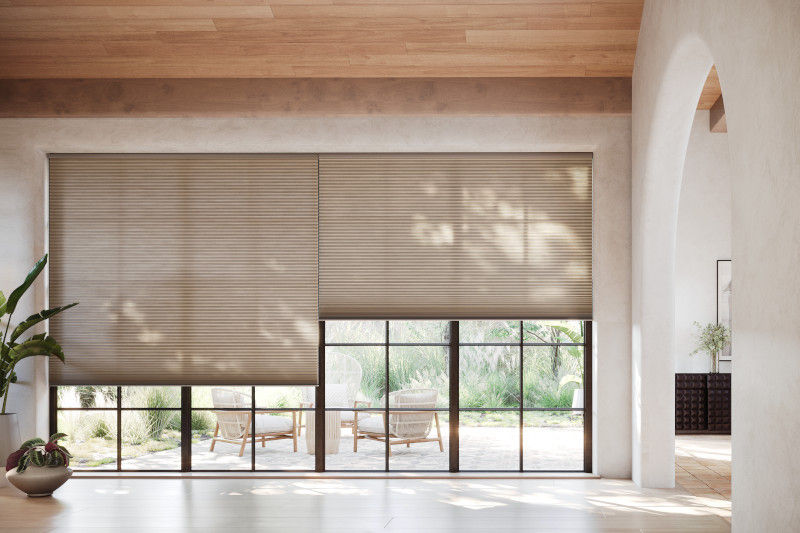
Cellular Shades for Comfort and Light Control
Cellular shades are made with structured fabric cells that create air pockets at the window. Their distinctive construction can help reduce heat transfer, making them a practical option for living rooms affected by seasonal temperature changes.
In the St. Louis region, homeowners experience hot summers, cold winters, and changing conditions between seasons. Windows can influence the comfort of a room, particularly when they are large or exposed to strong sunlight. Cellular shades add a layer at the glass while maintaining a relatively clean, understated profile.
These shades are available in different cell sizes, colors, opacities, and configurations. Light-filtering cellular fabrics can soften incoming daylight, while room-darkening versions provide greater light reduction. Although complete darkness is rarely necessary in a living room, a stronger opacity may be useful when glare is a persistent problem.
Cellular treatments can be some of the best shades for living rooms where homeowners value energy-conscious design and visual simplicity. They are particularly useful when the shade should support the room rather than become its primary decorative feature.
Certain cellular shades are available with top-down, bottom-up operation. This configuration allows the upper portion of the window to remain open for daylight while the lower portion stays covered for privacy. Product availability and operating options vary, so the desired configuration should be discussed during the consultation.
Woven Wood Shades for Natural Texture
Woven wood shades introduce organic color and texture through materials such as grasses, reeds, bamboo, or wood-based elements. Their natural variations make every shade visually distinctive and give the room a warm, relaxed character.
These treatments work particularly well in interiors that feature wood flooring, stone, natural textiles, or warm neutral colors. They can complement casual living rooms, updated traditional spaces, and rooms influenced by organic or collected design styles.
The open weave of some materials allows softened light to pass through, creating an inviting atmosphere during the day. However, openness also affects privacy. A material that looks sufficiently private in daylight may allow more visibility after dark when interior lights are on.
Adding a liner can increase privacy and improve light control. Liners may be light filtering or room darkening, depending on the product and the needs of the room. Some designs allow the liner and woven shade to operate separately for more flexible control.
For homeowners who want character rather than a perfectly uniform surface, woven treatments may be the best shades for living rooms. Blind Ambition’s design team can help compare natural materials and liners so the finished shade delivers the desired balance of texture, light, and privacy.
Solar Shades for Glare and UV Management
Living rooms with large windows often benefit from solar shades. These treatments are designed to reduce glare and manage the effects of sunlight while preserving some outward visibility.
Solar fabrics are available with different openness factors. A more open fabric typically provides a clearer view, while a tighter weave offers more sun control and privacy. Fabric color also affects performance and appearance. Darker fabrics may provide sharper outward visibility, while lighter colors can reflect more sunlight and create a brighter appearance inside.
Solar shades can be particularly helpful in rooms where afternoon sunlight reaches a television, seating area, artwork, hardwood floor, or upholstered furniture. Although no interior shade can prevent every effect of sunlight, solar materials can help reduce glare and limit UV exposure.
In sun-facing spaces, solar products are often among the best shades for living rooms because they manage brightness without completely separating the interior from the outdoor surroundings. This can be valuable for homes with attractive landscaping or views.
Homeowners should remember that solar shades are generally designed for daytime sun management rather than complete nighttime privacy. Once exterior conditions become darker than the illuminated interior, visibility may change. Drapery or a secondary shade can be added when stronger evening privacy is required.
Layered and Banded Shades for Flexible Coverage
Layered shades—sometimes called banded, zebra, or dual shades—use alternating sections of sheer and opaque fabric. As the shade is adjusted, these sections align or overlap to vary the amount of light and privacy.
When sheer sections align, daylight passes through and provides a partial view. When the opaque sections overlap, the shade offers greater coverage. The complete shade can also be raised when homeowners want to expose the window.
This visual movement makes layered shades appealing in modern and transitional living rooms. The horizontal bands provide more detail than a conventional roller shade while retaining a streamlined form.
Layered treatments may be the best shades for living rooms where homeowners want adjustable light control with a contemporary appearance. They are useful for managing changing conditions throughout the day without relying solely on raising or lowering the entire shade.
The material still affects privacy, glare, and view-through, so samples should be evaluated under the room’s actual lighting conditions. Blind Ambition can help homeowners compare band widths, colors, textures, and operating options to find a design that suits the window proportions.
Sheer Shades for Softened Daylight
Sheer shades combine soft fabric vanes with translucent material. The vanes can be adjusted to control light and privacy, creating an effect that feels lighter and softer than conventional blinds.
When the vanes are open, daylight filters through the sheer sections. When they are closed, the treatment provides increased coverage. The shade can usually be raised completely when an unobstructed view is preferred.
These treatments can work beautifully in formal and transitional living rooms where homeowners want adjustable light control without the harder visual lines of blinds or shutters. The soft construction can complement upholstered furniture, rugs, and decorative fabrics.
For a room designed around comfortable natural light, sheer treatments may be among the best shades for living rooms. They diffuse harsh brightness and create a gentle appearance at the window, which can make the entire space feel more inviting.
Because sheer materials do not perform like room-darkening fabrics, homeowners should carefully consider evening privacy and glare requirements. A professional consultation can determine whether sheer shades provide enough coverage on their own or should be paired with drapery.
Room-Darkening Shades for Media-Focused Spaces
Some living rooms also function as media rooms. Large televisions, projectors, and reflective screens can make direct sunlight especially disruptive. In these spaces, stronger light reduction may be more important than preserving the daytime view.
Room-darkening roller, cellular, or Roman shades can significantly reduce incoming light. However, homeowners should understand that a room-darkening fabric does not automatically create complete blackout conditions. Light may still enter around the edges of the treatment, particularly with an inside mount.
Outside-mounted shades can provide additional overlap around the opening. Certain products may also offer side-channel systems or specialized configurations designed to reduce light gaps. The correct approach depends on the window, surrounding trim, and desired level of darkness.
For media-focused spaces, the best shades for living rooms provide sufficient glare reduction without making everyday operation inconvenient. Motorization can be particularly useful because homeowners can adjust several shades together before watching television or a movie.
If complete darkness is not required, a light-filtering or solar shade may provide enough glare control while keeping the room brighter for general use. Blind Ambition can compare fabric samples and explain the expected performance of each opacity.
Privacy Considerations for Street-Facing Living Rooms
Many living rooms face the street or sit close to neighboring properties. Large windows may fill the space with welcome daylight while also exposing the interior to outside views.
Privacy needs change throughout the day. During daylight hours, some light-filtering materials obscure the interior while maintaining a soft glow. At night, interior lighting can make a room more visible from outside. A fabric that feels private in the afternoon should therefore be evaluated under evening conditions.
Top-down, bottom-up shades can be helpful when homeowners want to cover the lower portion of a window while admitting light from above. Layered shades provide adjustable bands of coverage. Roman shades with an appropriate lining offer a more substantial barrier, while woven shades may require a liner.
The best shades for living rooms give homeowners control over privacy without forcing the room to remain dark or completely closed throughout the day. Window position, surrounding landscaping, fabric opacity, and nighttime lighting should all influence the decision.
For additional coverage, custom drapery can be layered over shades. Drapery also brings softness and visual height to the room, making the combination both functional and decorative.
Coordinating Shades With Drapery
Layering shades and drapery gives a living room depth while expanding its light-control options. The shade handles everyday privacy and sunlight, while drapery frames the window and adds fabric, pattern, or color.
Stationary decorative panels can create a finished appearance without being intended to close across the entire opening. Functional drapery can provide another layer of privacy and light reduction when needed. The choice depends on the window width, available wall space, and desired result.
Proportions are important. Drapery hardware positioned higher above the window can emphasize ceiling height, while panels extending beyond the sides of the opening may make the window appear wider. Adequate space must be available for fabric to stack when the drapery is open.
When shades and drapery are used together, their colors do not have to match exactly. A neutral shade may support a patterned fabric, while a textured shade can add subtle contrast beneath solid drapery. The Blind Ambition team can coordinate materials so the layers feel connected rather than visually competitive.

Motorized Shades for Tall and Wide Windows
Motorization offers convenient control for living rooms with multiple windows, hard-to-reach openings, or large expanses of glass. Instead of walking around the room to adjust each treatment, homeowners can operate compatible shades using a remote, wall control, app, or integrated home system, depending on the selected product.
Motorized treatments can be adjusted individually or in groups. This makes it easier to create a consistent appearance across a bank of windows. Scheduled adjustments may also be available, allowing shades to respond to common routines or periods of strong sunlight.
For homeowners who value convenience, motorized products are frequently the best shades for living rooms. They are especially useful for tall windows, windows behind furniture, and open-concept spaces with several treatments.
Motorization should be planned early, particularly during new construction or a major renovation. The design team can review power options, wiring opportunities, battery accessibility, charging requirements, and control preferences before the shades are ordered.
The available capabilities vary by manufacturer and product. Blind Ambition can explain the compatible options and recommend a system that supports the homeowner’s daily routines.
Selecting the Right Fabric Opacity
Shade fabrics are generally offered in sheer, light-filtering, privacy, room-darkening, or solar variations. These descriptions help narrow the choices, but performance can vary among materials.
Sheer fabrics admit abundant daylight and preserve a visual connection to the outdoors. Light-filtering materials soften brightness while giving the window more coverage. Privacy fabrics obscure the view more substantially, while room-darkening materials limit a greater amount of light.
Solar fabrics are described partly by openness factor, which refers to the proportion of open space in the weave. A lower openness factor generally provides more sun control, while a higher openness factor offers a clearer view.
The best shades for living rooms use an opacity suited to the room’s orientation and privacy requirements. A north-facing room may need only gentle filtering, while a west-facing living room could benefit from stronger glare control in the afternoon.
It is helpful to view samples against the actual window. A fabric can look very different when illuminated by sunlight than it does when placed flat on a table. Blind Ambition’s complimentary in-home consultation gives homeowners the opportunity to evaluate materials within the room where they will be installed.
Color and Texture Matter
The color of a shade influences more than its decorative appearance. Light neutrals can brighten the room and blend with painted trim. Darker shades may create contrast and can coordinate with black window frames, dark hardware, or dramatic interior finishes.
Warm whites, creams, taupes, and natural textures complement many traditional and transitional St. Louis-area homes. Cool grays and crisp whites may work well in more contemporary interiors. Rich colors can create a focal point when the rest of the room is restrained.
Texture is equally important. A smooth roller fabric feels clean and minimal. A woven material introduces visible variation. A soft Roman fabric can make the window feel more furnished and complete.
Undertones should be compared carefully. Two materials described as white can look noticeably different when placed beside existing trim. The room’s daylight, lamps, flooring, and wall color can all affect how a fabric appears.
Blind Ambition’s interior design services help clients connect shade selections to the larger room. The goal is to choose a treatment that looks intentional with the architecture, furniture, and surrounding finishes.
Custom Measurements and Professional Installation
Living room windows are often prominent, so fit and alignment matter. Even small gaps or height differences can be noticeable when several treatments are installed side by side.
Professional measurement accounts for the width, height, depth, trim, sill, mounting surface, hardware clearance, and squareness of each opening. These details help determine whether an inside or outside mount will produce the best result.
An inside mount creates a contained appearance within the window frame, provided sufficient depth is available. An outside mount can cover more of the opening, conceal uneven trim, or reduce certain light gaps. The correct mounting style depends on the product and window conditions.
Professional installation ensures brackets are securely positioned, treatments align correctly, and operating components remain accessible. The installer can also test the shades and explain proper use.
This attention to detail is particularly valuable in older Kirkwood, Webster Groves, and St. Louis homes, where window openings may not be perfectly uniform. It is equally important in new construction, where large windows and open floor plans make alignment highly visible.
Explore Living Room Shades at the Blind Ambition Showroom
Selecting a window treatment is easier when you can see and operate full-size products. Blind Ambition’s showroom inside Mid Rivers Mall in St. Peters offers more than 8,000 square feet of premium blinds, shades, shutters, drapery, and motorized treatments.
A showroom visit allows homeowners to compare textures, study fabric opacity, test operating systems, and see how different treatments stack or roll when opened. Interior designers and home builders can also evaluate options for projects throughout the St. Louis and St. Charles areas.
After narrowing the possibilities, an in-home consultation allows the design team to evaluate the room itself. Samples can be compared with existing paint, trim, flooring, furniture, and natural light. The windows can also be professionally assessed for mounting requirements and operation.
Serving Living Rooms Throughout St. Louis and St. Charles
Blind Ambition serves homeowners, interior designers, and home builders throughout Affton, Chesterfield, Frontenac, Glendale, Huntleigh, Kirkwood, Ladue, Lake St. Louis, New Town and Orchard Farm, O’Fallon, St. Charles, St. Peters, St. Louis, Sunset Hills, Webster Groves, Wentzville, and surrounding communities.
With more than 10 years of experience, the team understands that successful window treatments must respond to both the home and the people who live there. The best shades for living rooms are selected through a collaborative process that considers sunlight, privacy, architecture, interior design, operation, and budget.
Blind Ambition offers a full range of custom products, so recommendations are not limited to one type of treatment. The team can compare roller shades, Roman shades, cellular shades, woven materials, solar fabrics, sheer treatments, blinds, shutters, and drapery to determine what works best for each window.
Schedule a Complimentary In-Home Consultation: The Best Shades for Living Rooms
Your living room shades should do more than cover the windows. They should make daylight easier to enjoy, support privacy, reduce disruptive glare, and contribute to a beautifully finished interior.
Schedule a complimentary in-home consultation with Blind Ambition to receive a customized quote. The team will assess your windows, discuss how you use the room, present suitable product options, and help coordinate materials with your interior.
Call (636) 579-4065 or email customerservice@blindambitionstl.com to begin planning your custom living room window treatments. You can also visit Blind Ambition’s 8,000-plus-square-foot showroom inside Mid Rivers Mall in St. Peters for a hands-on look at premium shades, blinds, shutters, drapery, and motorized solutions.


